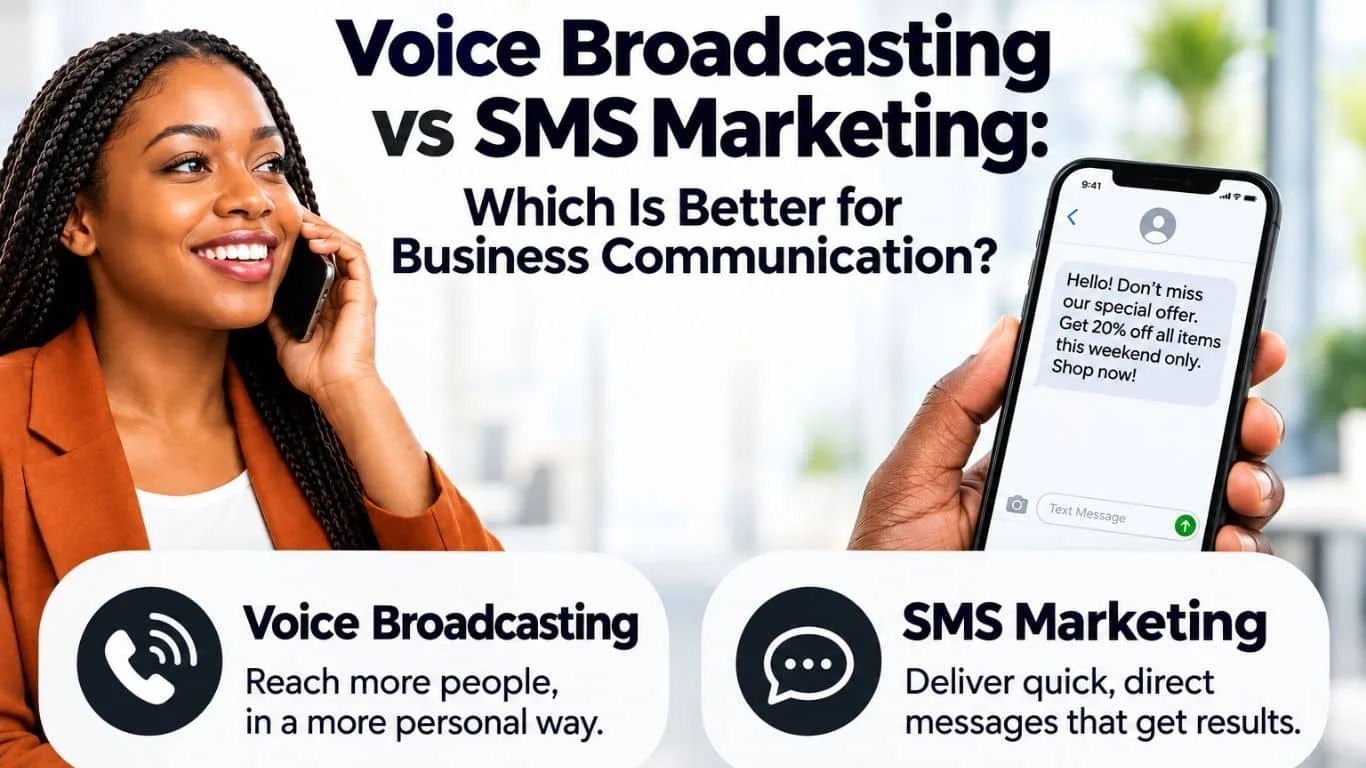

Voice Broadcasting vs SMS Marketing: Which Is Better for Business Communication?
Effective business communication in today’s fast paced digital marketplace, is the backbone of customer acquisition, retention, and brand loyalty. For enterprise organizations, microfinance institutions, e-commerce brands, and small businesses across Nigeria, reaching customers directly on their mobile phones is no longer optional it is critical. Nigeria’s telecommunications market has a massive reach, with active mobile subscriptions projected to approach 220 million by 2030,mobile channels offer an unmatched direct gateway to your target audience.
When planning an automated customer communication strategy, two channels dominate the conversation: automated voice calls and text messages. This brings modern growth marketers and operations managers to a crucial decision point when comparing voice broadcasting vs SMS. Which channel delivers better engagement, higher conversion rates, and superior return on investment for your business?
While both channels allow you to broadcast messages to thousands of recipients simultaneously across networks like MTN, Airtel, Glo, and 9mobile, they function very differently. In this comprehensive breakdown, we will evaluate bulk SMS vs voice broadcasting, examine their unique strengths, compare costs in Nigerian Naira (₦), and help you determine which tool best fits your customer outreach goals.
Understanding Voice Broadcasting for Nigerian Businesses
Voice broadcasting is an automated business communication strategy that allows you to send a pre-recorded audio message to thousands of phone numbers simultaneously. When the recipient answers their phone, the system plays your custom voice recording. Advanced voice broadcast systems also incorporate Interactive Voice Response (IVR) technology, allowing recipients to interact by pressing numbers on their keypad (for example, “Press 1 to speak with an agent” or “Press 2 to confirm your order”).
In Nigeria, voice calls vs SMS offer a unique human element. A voice broadcast can be recorded in English, Pidgin, Hausa, Yoruba, or Igbo, allowing businesses to speak to customers in their preferred dialect. This emotional touch makes voice broadcasting an effective vehicle for high priority alerts, political campaigns, loan repayment reminders, community announcements, and localized marketing campaigns.
Key Features of Voice Broadcasting
- Human Tone and Persona: Audio captures tone, urgency, and emotion far better than plain text.
- Multi-Language Accessibility: Overcomes literacy barriers by delivering messages in local Nigerian languages.
- Keypad Interaction (IVR): Enables immediate direct responses, call transfers, or survey participation during the live call.
- High Immediate Attention: A ringing phone naturally commands more urgent attention than an incoming text message notification.
Understanding SMS Marketing
SMS marketing involves sending promotional or transactional text messages directly to mobile devices in bulk. It remains one of the most widely deployed forms of automated customer communication worldwide due to its simplicity, speed, and massive reach across all types of mobile devices from basic feature phones (“torchlight phones”) to modern smartphones.
Bulk SMS is widely used by Nigerian banks, retailers, logistics companies, and schools to deliver short, direct information. Whether delivering one-time passwords (OTPs), promotional discount codes, flash sale alerts, or delivery updates, text messaging delivers concise content directly into the customer’s inbox.
Key Features of SMS Marketing
- High Open Rates: Text messages consistently achieve open rates above 90%, with most messages read within minutes of delivery.
- Asynchronous Convenience: Customers can read and reference text messages at their convenience without interrupting their ongoing activities.
- Clickable Hyperlinks: Plain text messages allow you to include web links, guiding users straight to your payment page, website, or mobile application.
- Permanent Inbox Record: Messages remain saved in the user’s phone, making it easy for them to store coupon codes, account numbers, or address details.
Voice Broadcasting vs SMS: Detailed Side-by-Side Comparison
To choose the right tool for your organizational goals, it helps to evaluate bulk SMS vs voice broadcasting across critical operational metrics.
1. Audience Reach and Literacy Accessibility
One of the most significant advantages of voice broadcasting in the Nigerian context is its ability to bypass text literacy challenges. While SMS requires the recipient to read English or text based scripts, voice messages communicate directly through spoken audio. A microfinance bank reaching rural farmers in Kano or an agricultural cooperative sending weather updates in Benue can achieve far better understanding using voice broadcasting in native dialects than through text messages.
2. Message Delivery and Urgency
When comparing voice calls vs SMS for urgent alerts, timing is everything. A text message sits in an inbox until the user checks their phone. While open rates are high, a customer might not look at an SMS for hours. Conversely, a phone call demands instant attention. If your business needs to communicate an urgent update such as emergency service disruptions, fraud alerts, or immediate appointment confirmations, voice broadcasting creates an immediate reaction that text messages cannot match.
3. Engagement and Interactive Capabilities
SMS is predominantly a one way communication channel unless connected to a short code or web link. If a customer receives a promotional text message while driving or offline, they cannot take immediate action. Voice broadcasting with IVR allows immediate dynamic engagement. A customer can listen to a payment reminder and instantly press a button to connect to a live customer support representative in Lagos or Abuja, drastically reducing friction in the conversion funnel.
4. Regulatory Compliance and DND Restrictions
The Nigerian Communications Commission (NCC) enforces strict Do Not Disturb (DND) regulations to protect consumers from unwanted spam. Both bulk SMS and voice calls must respect DND policies. However, transactional voice calls and opt in automated voice broadcasts frequently experience higher successful delivery rates across DND active lines when routed through specialized enterprise telecommunication routes compared to standard promotional SMS.
5. Cost Considerations and Pricing Models in Nigeria
Cost efficiency plays a major role in choosing any business communication channel. In Nigeria, pricing structures for these channels reflect their underlying technology infrastructure.
- Bulk SMS Pricing: Bulk SMS is typically billed per standard 160-character message unit. Rates in Nigeria generally range between ₦4.00 and ₦6.00 per SMS, depending on the network provider and purchasing volume. Text messaging is highly cost effective for large scale broadcast campaigns reaching tens of thousands of users simultaneously.
- Voice Broadcasting Pricing: Voice broadcast calls are typically charged based on connected call duration, usually billed in 30second or 60second billing increments. In Nigeria, rates for automated voice calls typically range from ₦12.00 to ₦25.00 per connected 30second call segment. While more expensive per contact than text messaging, the conversion and engagement rates from direct voice interactions often deliver a higher return on investment for high value offers.
When Should Your Business Use Voice Broadcasting?
Automated voice messages deliver maximum value in scenarios that require high personal trust, immediate action, or native language options. Ideal use cases include:
- Debt Collection and Payment Reminders: Financial institutions, loan apps, and microfinance banks achieve significantly higher recovery rates when reminders feature polite, human voice prompts in local languages.
- Political and Community Outreach: Candidates running for office can broadcast localized voice messages to thousands of voters simultaneously, bringing warmth and personal presence to their political campaign.
- Emergency Notifications: Security firms, educational institutions, and healthcare providers use automated calls for urgent safety advisories where immediate awareness is vital.
- Interactive Customer Surveys: Gathering quick feedback via automated IVR keypresses (“Rate our service from 1 to 5”) yields faster completion rates than sending external survey links via SMS.
When Should Your Business Use SMS Marketing?
Text messaging excels when delivering concise information that customers need to reference later. Ideal use cases include:
- E-Commerce Order Confirmations: Sending dispatch updates, tracking codes, and delivery driver phone numbers directly to a customer’s inbox.
- Transactional Banking Alerts: Delivering real-time debit alerts, credit notifications, and multifactor authentication One Time Passwords (OTPs).
- Promotional Coupons and Sales: Blasting flash sale discount codes along with direct web links driving customers to your online store.
- Event Details and Venue Directions: Distributing addresses, ticket codes, and event schedules that attendees need to display at the entrance door.
Combining Voice Broadcasting and SMS: The Hybrid Approach
Rather than treating voice broadcasting vs SMS as a strict either-or decision, forward thinking Nigerian enterprises achieve the highest engagement rates by adopting a multichannel hybrid strategy. By integrating both tools into an automated customer communication sequence, you can maximize your total outreach effectiveness while managing costs intelligently.
For instance, a modern financial services company in Nigeria can set up an automated communication workflow that follows these strategic steps:
- Step 1 (Day 1): Send an automated SMS reminder regarding an upcoming bill payment (Cost: approximately ₦6.00).
- Step 2 (Day 3): If the bill remains unpaid on the due date, trigger an automated voice broadcast call with a friendly payment reminder and IVR transfer option to a support representative (Cost: approximately ₦25.00).
- Step 3 (Post-Call): Immediately follow up with a automated SMS containing a direct quick payment link for mobile banking apps.
This combined workflow respects customer communication preferences, captures attention at multiple touchpoints, and ensures maximum campaign conversion rates.
Conclusion: Which Channel Wins for Your Business?
When weighing voice broadcasting vs SMS, there is no single universal winner. The ideal choice depends entirely on your target demographic, your budget, message urgency, and specific campaign objectives.
Choose SMS Marketing if you need a cost effective, concise, and scalable method to send clickable links, reference information, and short promotional updates to a tech savvy audience across Nigeria. Choose Voice Broadcasting if you are driving urgent actions, navigating literacy barriers, collecting loan repayments, or building personal emotional connections through local dialects like Pidgin, Hausa, Yoruba, or Igbo.
By assessing your operational goals and budget realities, you can deploy the right mix of bulk SMS vs voice broadcasting to build stronger customer connections and scale your business communications efficiently.
Ready to improve your customer communication? Let Camillo help you choose the right mix of Bulk SMS and Voice Broadcasting. Contact us today to get started.